EYFS
Welcome to Early Years
We know that starting Nursery or Reception is a very special time, and we are committed to making every child feel happy, safe and valued from the moment they join us. Our Early Years classrooms are warm, nurturing environments where children are encouraged to explore, play, ask questions and develop a love of learning.
Through a carefully planned curriculum, rich language experiences and meaningful first-hand learning opportunities, children build confidence, independence and curiosity about the world around them. We value each child as an individual and work closely with families to ensure every child thrives socially, emotionally and academically. By providing a balance of child-led play, adult-guided learning and exciting experiences both indoors and outdoors, we help children develop the skills, knowledge and confidence they need for a successful start to school and a smooth transition into Year 1.
Our aim is simple: for every child to leave Early Years as a happy, confident and enthusiastic learner, ready for the next stage of their journey.
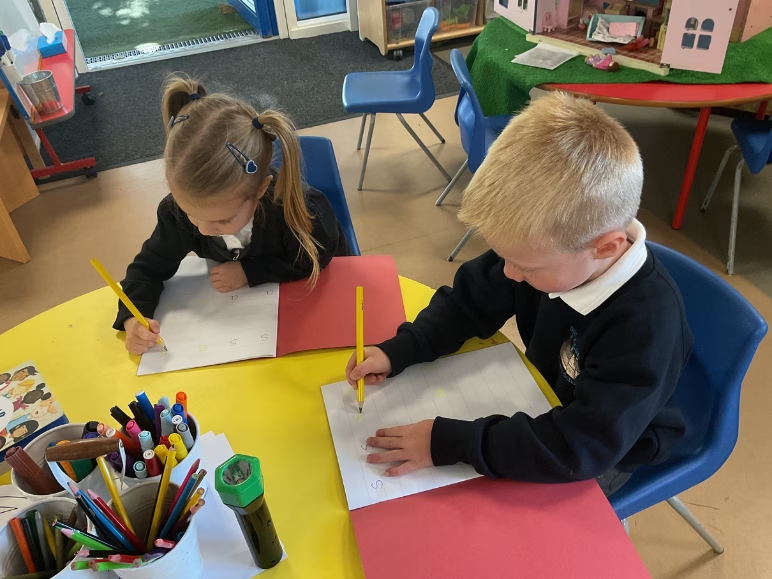

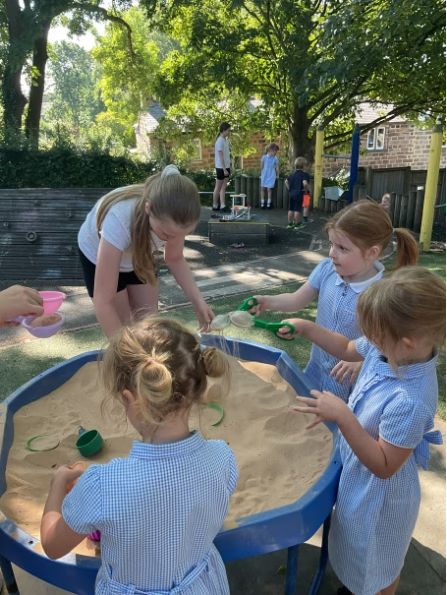
Early Years at Spofforth
EYFS Curriculum Intent
At our school, we intend for all children to become confident, curious and independent learners who develop a love of learning from their earliest experiences. Through a nurturing and language-rich environment, children build secure foundations across all seven areas of learning whilst developing the knowledge, skills and vocabulary needed for future success.
Our curriculum is carefully sequenced from Nursery to Reception and is underpinned by high-quality interactions, play-based learning, meaningful first-hand experiences and children’s interests. We aim for all children to:
- Develop strong communication and language skills through stories, songs, conversations and rich vocabulary experiences.
- Build positive relationships, resilience, self-regulation and independence.
- Develop a love of reading, storytelling and early literacy.
- Become confident mathematicians with secure number sense and problem-solving skills.
- Understand the world around them through exploration, investigation, seasonal change and knowledge of their community.
- Develop physically through daily opportunities to refine both gross and fine motor skills.
- Express themselves creatively through art, music, performance, storytelling and imaginative play.
- Be fully prepared for a successful transition into Reception and then Key Stage 1.
EYFS Curriculum Implementation
Our curriculum is delivered through a balance of carefully planned adult-led teaching, high-quality interactions and child-initiated learning within a stimulating indoor and outdoor environment.
Communication and Language
Children are immersed in language through:
- Daily story times.
- Nursery rhymes, songs and poems.
- Show-and-tell opportunities.
- Sustained conversations with adults and peers.
- Explicit vocabulary teaching linked to themes, texts and experiences.
- Carefully planned opportunities to listen, respond, question and explain.
Personal, Social and Emotional Development
Children develop confidence and independence through:
- Strong key-person relationships.
- Consistent routines and expectations.
- Kapow PSHE units.
- Circle times and discussion of feelings.
- Opportunities to collaborate, share and solve problems.
- Responsive teaching that addresses the needs of individual children and cohorts.
Physical Development
Physical skills are developed through:
- Daily outdoor provision.
- Hall sessions and PE programmes.
- Gross motor activities including climbing, balancing, riding and ball skills.
- Fine motor activities such as dough gym, threading, construction, cutting and mark making.
- Opportunities to develop independence through dressing, toileting and self-care routines.
Literacy
Children develop early reading and writing through:
- Daily story sessions and high-quality texts.
- Little Wandle Foundations in Nursery and Little Wandle Phonics in Reception.
- Repeated story experiences and book talk.
- Mark making opportunities throughout provision.
- Progressive writing activities from emergent mark making to captions, sentences and simple narratives.
Mathematics
Children learn mathematics through:
- White Rose Maths and Mastering Number approaches.
- Daily counting, subitising and number exploration.
- Meaningful practical experiences.
- Investigation of shape, space, measure and pattern.
- Continuous opportunities to apply mathematical understanding within play.
Understanding the World
Children gain knowledge of the world through:
- Seasonal walks and outdoor learning.
- Observing life cycles and growing plants.
- Learning about their families, community and local area.
- Celebrating a range of cultural and religious events.
- Maps, technology and enquiry-based activities.
- First-hand experiences that encourage curiosity and questioning.
Expressive Arts and Design
Creativity is developed through:
- Music, singing and performance opportunities.
- Poetry baskets and storytelling.
- Role play and small world experiences.
- Drawing, painting, sculpture and junk modelling.
- Exploration of materials and artistic techniques.
- Opportunities to create, evaluate and develop their own ideas.
Assessment is ongoing and informs planning. Adults continually observe, assess and respond to children’s interests, needs and next steps, ensuring learning remains ambitious and relevant for every child.
EYFS Curriculum Impact
As a result of this curriculum, children make strong progress from their individual starting points and develop the knowledge, skills and attitudes needed for future learning.
By the end of EYFS, children:
- Communicate confidently using an increasingly rich vocabulary.
- Listen attentively and respond appropriately in a range of situations.
- Demonstrate resilience, independence and positive attitudes to learning.
- Form strong relationships and show empathy towards others.
- Read with growing fluency and comprehension using secure phonic knowledge.
- Write for a range of purposes using their developing phonics and transcription skills.
- Demonstrate secure number sense and mathematical understanding.
- Show curiosity about the natural world, their community and wider society.
- Apply physical skills with increasing control, coordination and confidence.
- Express themselves creatively and imaginatively.
- Are well prepared for the transition into Key Stage 1.
Children leave EYFS as confident, capable and enthusiastic learners. They demonstrate strong communication skills, positive learning behaviours and secure foundations across all areas of learning. Through a carefully sequenced curriculum, rich first-hand experiences and highly responsive teaching, children are equipped with the knowledge, skills and dispositions required for success in Year 1 and beyond.